CS
Portfolio Case Study
Limited-Time Discount System
Growth Design / Monetization / AI Product

Designing a limited-time discount system that felt urgent, not cheap.

This project transformed a previously proven but visually rough discount tactic into a reusable conversion system for an AI product. I focused on the moment when free users first experienced success, then designed a chain of monetization touch points that could push toward payment without breaking the product experience.

The core challenge was not whether discounts could work. Historical experiments had already validated them. My job was to professionalize the system: tighter trigger logic, stronger continuity across surfaces, and a visual direction that balanced conversion pressure with brand integrity.

Role Lead Product Designer
Scope Monetization UX, UI system, stakeholder alignment
Audience Unconverted free users and high-intent non-paying users
Primary Question How might we shorten the path from aha moment to checkout?
Project Overview

From a rough growth tactic to a portfolio-worthy monetization system.

The business had already seen evidence that discount-based offers could help paid conversion. The problem was execution. The journey was fragmented, urgency disappeared too quickly, and the UI lacked the polish expected from an AI product. I reframed the work as a system design challenge rather than a single modal design task.

Business Goal

Increase ARR by introducing more deliberate discount strategies for two target segments: free users who had not converted yet, and highly active non-paying users who had already moved past a typical recharge cycle in T1 and T2 markets.

Design Goal

Build a full conversion path that captures attention at the right time, keeps the offer visible long enough to matter, and leads users toward checkout without damaging the calm, premium feel of the product.

Framing This was not a speculative experiment. It was the systemization of an already-validated growth lever. That framing made the work more strategic: I was asked to turn ad hoc learnings into durable product infrastructure.
Why This Opportunity

I anchored the design around the first real product success moment.

I reviewed the product journey and identified three moments when users might feel the strongest value. The key was finding the point where motivation was high enough to act but the experience was still fragile enough to lose if we pushed too hard.

Aha Moment 1

First preview appears

The most scalable trigger. Emotional payoff is immediate, and earlier data showed this moment had the largest opportunity surface.

Aha Moment 2

After multiple refinements

Satisfaction may be high, but the product could not reliably detect that precise moment yet, making activation difficult to operationalize.

Aha Moment 3

Verification of DR sources

Useful in theory, but usage of this behavior was low at roughly 4%, so it could not be the main monetization anchor.

Why first preview won

  • It captured the highest emotional peak in the journey.
  • It had the broadest reach across users.
  • It was already supported by historical growth signals.
  • It created a natural bridge from value realization to paid intent.

What made it risky

  • A modal could interrupt the conversation flow.
  • The offer might disappear too fast after dismissal.
  • Overly promotional visuals could cheapen the brand.
  • Without continuity, the jump from excitement to pricing remained too long.
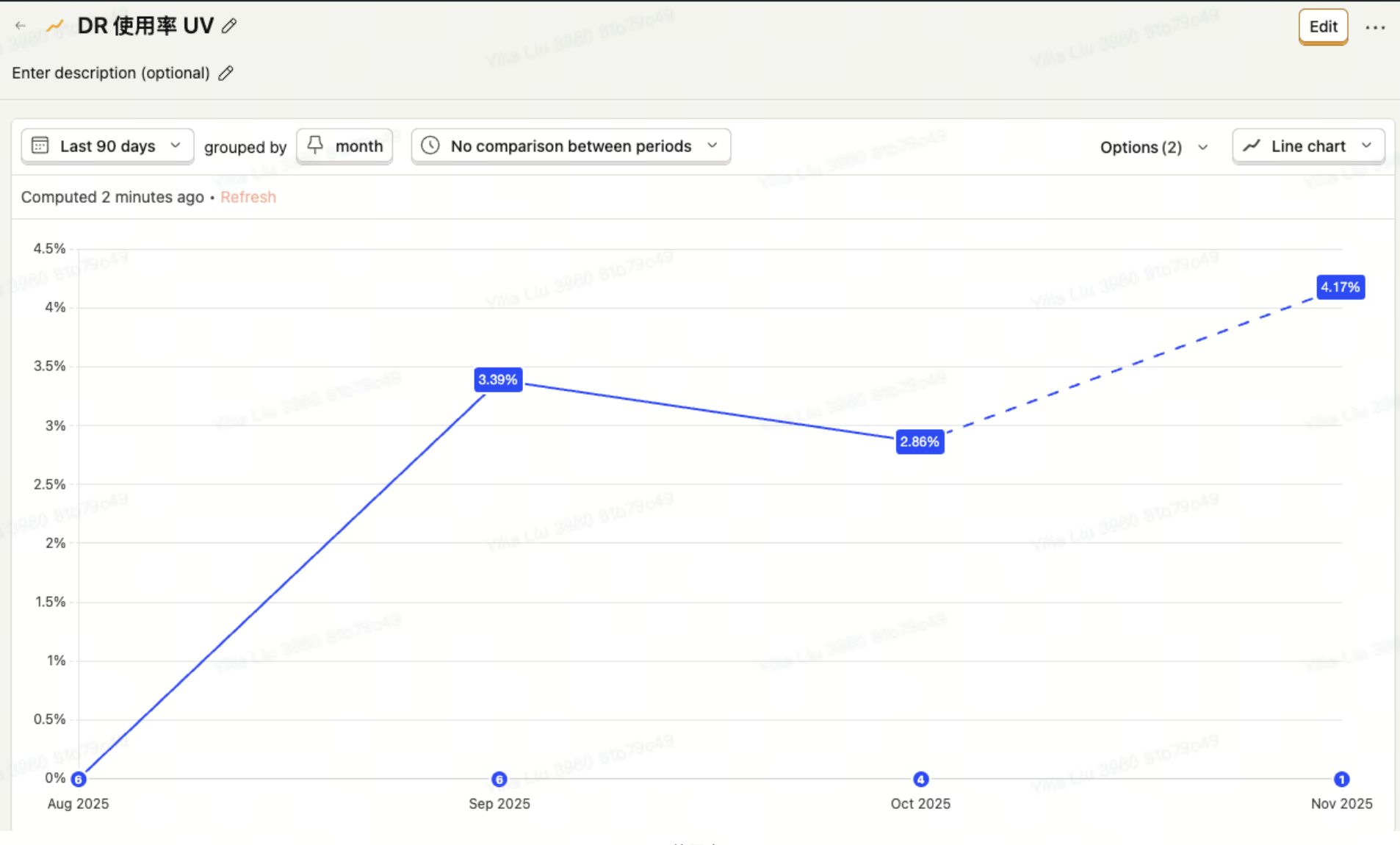
Historical chart showing discount-related DR usage trend peaking at 4.17 percent
Historical data from earlier PRD validation showed that discount mechanics had already worked before. This chart was important context: I was not inventing the tactic from scratch, but refining and professionalizing it.
The Conversion System

I designed an end-to-end sequence: trigger, nudge, and checkout continuity.

Instead of treating the discount as a one-time pop-up, I built a connected experience across the product. Each touch point had a distinct job: create immediate excitement, preserve urgency, and keep the offer legible all the way into payment.

K1

The Trigger

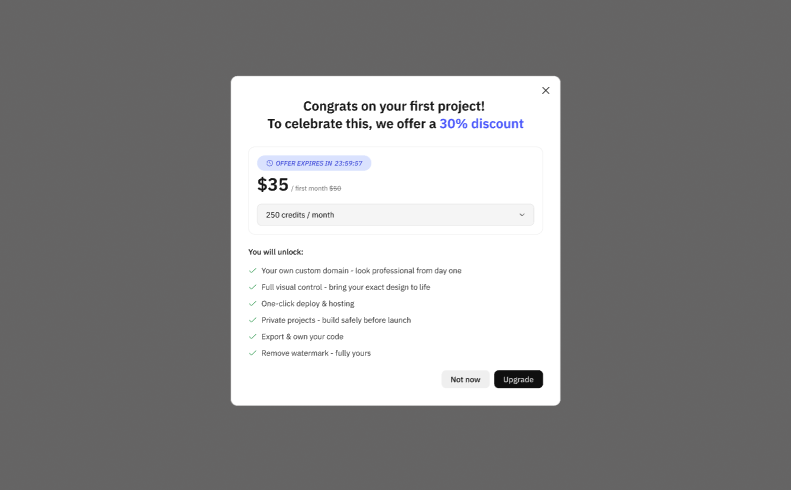
A modal appears at the first preview to celebrate success and present the limited offer at the moment of maximum excitement.

K2

The Nudge

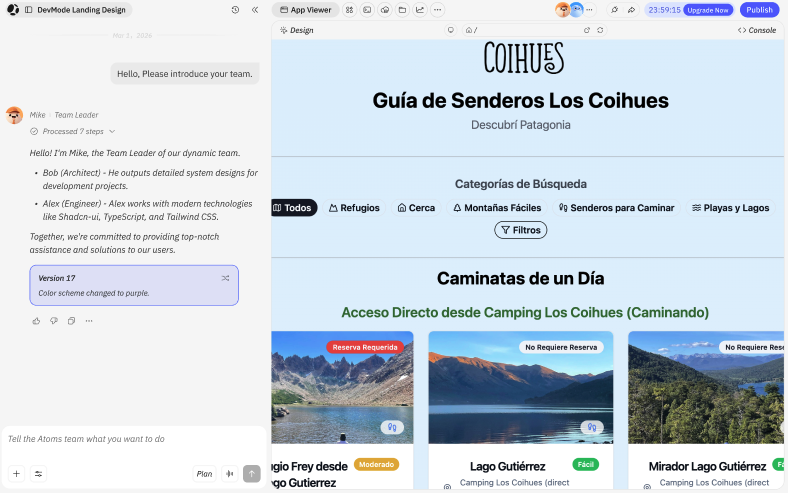
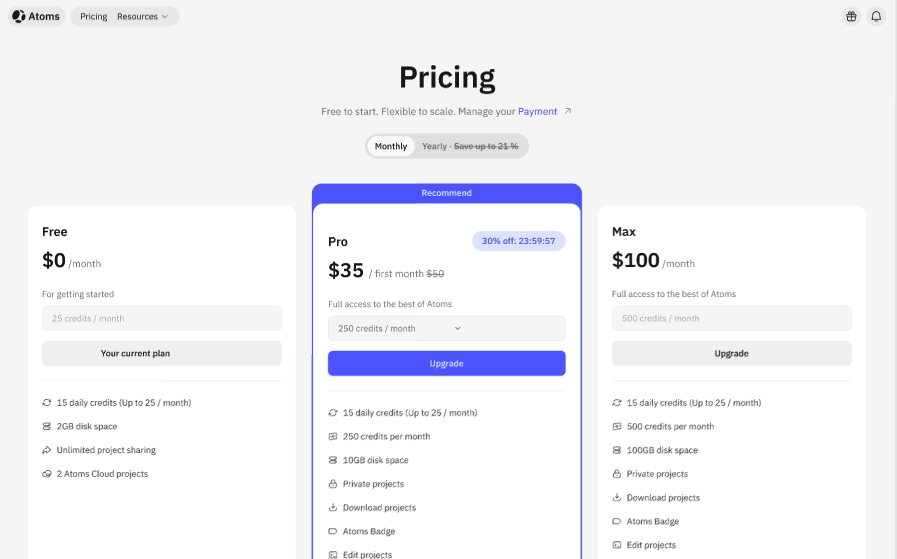
A countdown component persists inside chat and pricing contexts after dismissal, so users do not forget the offer while continuing to explore.

K3

The Reminder Layer

A top navigation banner keeps the discount visible in a low-friction location, extending the conversion path beyond the chat canvas.

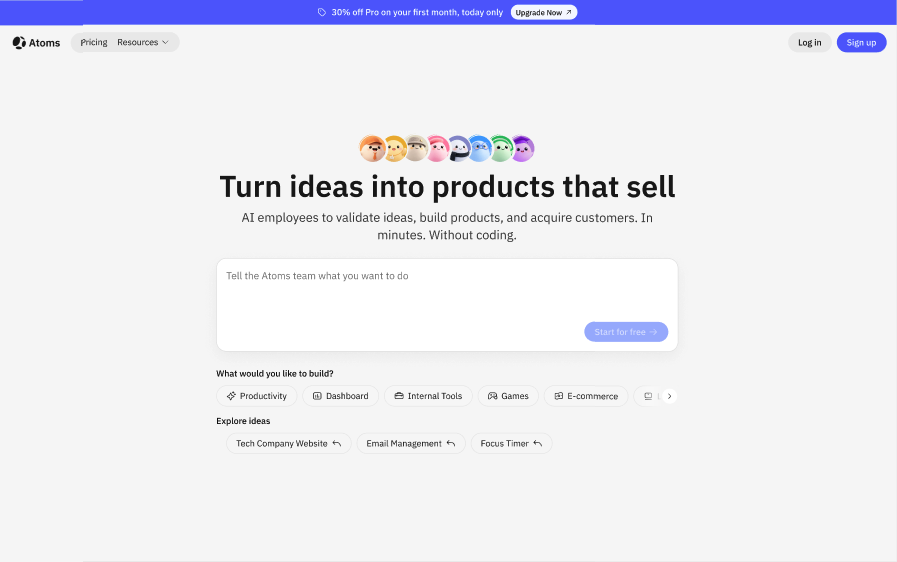
Homepage with top banner for the offer
The top-level banner expanded the system beyond modal logic. It acted as a gentle recall mechanism for users who returned to the product or navigated between surfaces before deciding to pay.
Design Details

I treated the countdown as a reusable product component, not a one-off campaign asset.

One of the most important design decisions was turning the promotion into a modular UI system. That meant defining component behavior, responsive rules, copy variations, and a consistent urgency language that could adapt across surfaces without feeling noisy.

Content System

Message hierarchy

I separated the experience into celebration, offer, and capability unlocks. This kept the modal from reading like an ad and instead framed it as a next step in the product journey.

Component Spec

Adaptive countdown behavior

The countdown treatment was designed to work as a modal pill, a chat-level banner, and a pricing-page accent. Copy, spacing, and emphasis were tuned per context and adapted for mobile constraints.

UX Principle

Low interruption, high recall

The user could dismiss the modal and keep building. That reduced resentment while the follow-up components kept the commercial message alive in lighter-weight forms.

Surface Purpose Design Behavior
Preview Modal Capture peak emotion Celebratory framing, focused value stack, strong CTA, optional dismissal
Chat Banner Prevent forgetting Persistent but compact countdown treatment that stays visible during continued work
Pricing Surface Reduce context switch Reuses the same time-sensitive language and visual markers to keep the offer legible
Global Banner Extend reach Low-friction reminder layer for users navigating between homepage and pricing
Trade-offs

The hardest problem was balancing conversion pressure with a premium AI brand.

Internally, the team disagreed on how aggressive the visual language should be. Brighter options promised stronger click-through. Darker, quieter options better fit the brand. Without immediate experiment data, I had to turn a subjective design debate into a structured decision process.

Business constraint

The UI needed enough visual break to win attention inside a short decision window. If the discount did not feel urgent, the offer would simply disappear into the surrounding product interface.

Brand constraint

The product was an AI tool, not low-end commerce. Overusing promotional colors or noisy visual language risked undermining trust, professionalism, and product immersion.

Direction A

High contrast, high urgency

Strongest conversion pressure, but visually aggressive and more likely to damage the product’s premium feel.

Direction C

Brand color plus subtle gradient

The chosen balance. It kept enough contrast to signal urgency while staying inside the visual language of the product.

Direction E

Minimal, quiet treatment

Best for brand purity, but easier to ignore and less effective as a limited-time commercial intervention.

Decision Lens How I Evaluated It Why It Mattered
Conversion Pressure Predicted click motivation and ability to stand out in the user’s attention window Too weak, and the offer becomes invisible
Brand Damage Risk Likelihood that the UI would feel cheap, noisy, or off-brand for an AI product Too strong, and short-term lift harms long-term trust
Development Feasibility Effort to ship consistently across modal, chat, pricing, and top-nav surfaces Pragmatism mattered because the team needed to move quickly
Decision-Making in Ambiguity I organized a focused critique with PM, UI design, the founder, data, and SEO, then used a silent-reading format plus a pros-and-cons matrix to guide the discussion. This cut decision time by roughly 50% and replaced taste-based disagreement with a shared evaluation framework.
Process

I moved the team from fragmented opinions to a repeatable design logic.

Beyond the UI itself, the most senior part of the project was the decision process. I was not only designing screens. I was structuring how the team made trade-offs when data was incomplete and stakes were high.

01

Audit

Reviewed historical experiments and clarified where discount had already proven value.

02

Select

Mapped three candidate aha moments and chose first preview as the core trigger.

03

Systemize

Connected modal, chat banner, pricing, and top nav into one conversion chain.

04

Critique

Prepared five visual directions with explicit trade-offs instead of subjective polish rounds.

05

Align

Used a decision matrix and silent review to reach consensus and ship a balanced solution.

Interview Angle

The strongest talking points were about judgment, not just screens.

I shaped this project into a case study that shows senior-level design thinking: knowing when to ship, when to formalize a component system, and how to create clarity for a cross-functional team when the data does not answer every question.

Why not run an A/B test immediately?

At that stage, the primary risk was not the exact color treatment. It was whether the end-to-end monetization path could be shipped coherently and fast enough to support the business. I prioritized operationalizing the validated discount logic first, then positioned color-level A/B testing as a later iteration for targeted markets.

How did I influence the decision?

I reframed a visual disagreement into a weighted evaluation problem. By comparing multiple directions against conversion pressure, brand impact, and build effort, I created a neutral structure that helped the team decide faster and with more confidence.

How did I collaborate across functions?

I involved PM, design, founder, data, and SEO in the same critique loop. The silent-reading format gave stakeholders space to understand the logic before reacting, which improved the quality of feedback and reduced aesthetic noise.

Takeaways

This project shows my strength in designing under complex constraints.

The most meaningful outcome was not a single screen. It was the ability to define an optimal solution between business urgency and brand trust, then help the organization align around that solution with a clear, documented logic.

1

System thinking matters

A monetization surface is rarely successful in isolation. The real leverage comes from connected touch points that reinforce the same user intention over time.

2

Brand is part of conversion

Aggressive design can win clicks in the short term, but premium products need to protect trust. Conversion design should feel intentional, not desperate.

3

Design leadership is decision leadership

When data is incomplete, senior designers create structure. The decision matrix and review process were as valuable as the final UI.

Final Reflection When business goals clash with brand identity, my job is to find the best solution inside the constraint, not to optimize one side at the expense of the other. That balance is the most durable edge I bring as a product designer.